The Money
Café
CREDIT Credit on The Money Café
Dictionary Definition of Credit — used to denote transactions involving the transfer of money or other property on promise of repayment, usually at a fixed future date. The one who gives the credit thereby becomes a creditor, and the one who receives it, a debtor. The principal function of credit is to transfer property from those who own it to those who wish to use it. With credit, property that would otherwise lie idle is used, thus enabling a country to employ its resources more fully. Definition of Credit According to Charles Dickens — Credit is a system whereby a person who can't pay gets another person who can't pay to guarantee he can pay. Seven Types of Credit on The Money Café
Credit Cards Lead to an Ugly Goose Egg Instead of a Nice Nest EggThere's nothing quite so powerful as credit to ensure that you get a ugly goose egg instead of a nice nest egg in your retirement portfolio. Especially if your brain has a spending mind of its own, the best thing is to stay away from credit cards and pay-now-and-get-into-trouble-later plans. Otherwise, the whole game of credit will eventually snowball. Before you know it, there will be a financial avalanche that you will want to blame on mystical forces beyond your control. When you run out of credit, there will be no place to run to, no place to hide. You will need someone to bail you out big time. And unless you have a wealthy, benevolent relative, that someone is going to be you.
Oddly enough, during the biggest boom time the U.S. has ever experienced, more people than ever have serious money problems due to credit. A record number of over 2-million personal bankruptcies were reported for the year previous to the one in which this book was written. One in every 55 families went bankrupt that year. Although unexpected events, such as divorce, unemployment, and illness, contribute to money problems, lifestyle financed by debt is normally the main cause. In an attempt to keep up with relatives, friends, and coworkers — most of whom are members of the bastard rich — people start borrowing money and using credit cards to support a lifestyle they can't afford. In the process of joining the bastard rich, they end up with a pile of debt that ends up ruining their lives.
It's not hard to become one of the bastard rich when one has five or six credit cards. In fact, the average American has five cards and the average Canadian has three. However, there is no end to the number one can get. Walter Cavanagh, a financial planner living in Santa Clara, CA, collects credit cards just like some people collect stamps and coins. At last count, according to the Guinness Book of Records, Cavanagh has 1,397 cards with a total limit of $1.65-million.
People in debt with four or five cards should perish the thought of getting a few more to tide them over until things get better. Roy W. Walters warned, "If you're already in a hole, it's no use to continue digging." Yet, credit often becomes a way for people to avoid their financial messes. Most people who use their credit cards recklessly seem to have lost touch with financial reality. Moreover, their condition seems to worsen with time. The more cards they have, the more oblivious to prices they become, and the more things they buy that they don't need and can't afford.
The magic of credit cards can even create a temporary illusion of
As a Zen-Rich individual on the way to creating more wealth than your doctor, the best thing you can do is avoid credit and pay for everything by cash, with the possible exceptions of homes and cars. For sure, only a small percentage of people do this. However, paying cash for everything is one way of showing that you are truly free from being influenced by what most people in society are doing. This is not to say that as a Zen-Rich individual you shouldn't have a credit card or two. Use your credit cards for convenience only and be absolutely sure that you can pay the bills at the end of the month. Whenever there is something you want, but don't have the money in your bank account to pay for it, it's best to wait. Some luxurious living is good for your prosperity consciousness and ability to build wealth for the future. However, if it's financed by credit and you let it go too far, you will pay for it by having to live on a meagre level down the road. In the event that you can't use credit cards wisely — and most people can't — it's best that you get rid of them immediately. The worst thing you can do for yourself — and the best thing you can do for the credit card companies — is to greedily use your credit cards and look at the limits as required spending amounts. When you approach your limit, the credit card companies will immediately designate you as one of their favorite suckers (okay, "customers" if you can't handle the truth).
Then they will increase your limit hoping you become even a bigger sucker. The more debt you have, and the longer it takes to pay off, the richer the credit card companies become off the interest you pay, and the less money you have for yourself. An alternative lifestyle may seem appealing and much superior to the one you have now. However, whenever it is financed by credit, it certainly won't be for long. Sooner or later, it will occur to you that the party can't go on forever. At this point, you will lose self-respectfor having allowed yourself to get into serious debt. Furthermore, credit misuse can have other serious implications. Racking up more debts than they are able to handle leads to severe stress for most people. This can result in anxiety, various illnesses, and absenteeism from work. People in financial trouble are known to smoke too much, have substance abuse problems, use too many prescription drugs, and blame loved ones for their shortcomings.
Truth be known, we don't need credit cards to be prosperous in this day and age. There was little credit available in our forefathers' time, and they certainly had no credit cards. Yet, they got by just fine. Personally, although I use credit cards for convenience and to collect airmiles, I choose to earn my dollars before I spend them. This way, I don't delude myself about what I own and what I don't own. When I purchase a car, I know that I own it completely because I don't owe a cent on it. Of course, I also save the exorbitant interest charges that accompany all credit purchases. Earning my money before I spend it helps me save thousands of dollars in credit charges which, in turn, brings me closer to financial independence.
There is another reason why Zen-Rich wisdom advocates that you earn your money before you spend it. Buying something on credit makes it appear easy; however, like everything else in life, you won't appreciate something that comes too easy. Buying something on credit is tantamount to getting something without earning it. Getting something without effort results in little appreciation for it from the moment you bring it into your world. On the other hand, making sacrifices along the way adds to the satisfaction of acquiring an
object that is deemed to be worth something. You have to admit that the value of a possession is much higher
when you have had to work long and hard for it, and at the same time, wait to get it. THE MONEY CAFÉ COPYRIGHT © 2015 by Ernie J. Zelinski |

BEST GIFT BOOKS FOR YOUR MONEY
THE WORLD'S BEST RETIREMENT BOOK by Ernie Zelinski
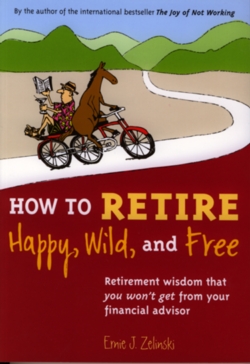
OVER 250,000 COPIES SOLD
PUBLISHED IN 8 FOREIGN LANGUAGES
Purchase How to Retire Happy, Wild, and Free on Amazon.com with this direct link:
How to Retire Happy, Wild, and Free on Amazon.com
THE CAREER BOOK FOR PEOPLE TOO SMART TO WORK IN CORPORATIONS
CAREER SUCCESS WITHOUT A REAL JOB
Purchase Career Success Without a Real Job directly through these links:
Career Success Without a Real Job on Amazon.com
and
Career Success Without a Real Job on B&N.com
THE JOY OF NOT WORKING: A BOOK FOR THE RETIRED, UNEMPLOYED, & OVERWORKED

OVER 280,000 COPIES SOLD
PUBLISHED IN 17 LANGUAGES
Purchase The Joy of Not Working on Amazon.com with this direct link:
The Joy of Not Working on Amazon.com
THE JOY OF NOT WORKING: A BOOK FOR THE RETIRED, UNEMPLOYED, & OVERWORKED
OVER 280,000 COPIES SOLD
PUBLISHED IN 17 LANGUAGES
Purchase The Joy of Not Working on Amazon.com with this direct link:
The Joy of Not Working on Amazon.com
KINDLE EDITION
101 REALLY IMPORTANT THINGS YOU ALREADY KNOW, BUT KEEEP FORGETTING

PUBLISHED IN 9 LANGUAGES
Purchase 101 Really Imporant Things You Already Know, But Keep Forgetting on Amazon.com with this direct link:
101 Really Important Things on Amazon.com
THE WORLD'S BEST RETIREMENT BOOK by Ernie Zelinski
OVER 250,000 COPIES SOLD
PUBLISHED IN 8 FOREIGN LANGUAGES
Purchase How to Retire Happy, Wild, and Free on Amazon.com with this direct link:
How to Retire Happy, Wild, and Free on Amazon.com
The Money
Café
www.the-money-cafe.com